How CCC Built a Billion-Dollar Supplier Network, One Workflow at a Time
At Collective Live 2025, Marc Fredman broke down CCC’s forty-year climb: from a point solution to the operating fabric of the auto-insurance economy
.png)
Some talks explain a product. In this presentation at VSaaS Collective Live at San Francisco’s Commonwealth Club on November 5, Marc Fredman explained an industry. His walkthrough of CCC’s forty-year climb — from a point solution to the operating fabric of the auto-insurance economy — was a reminder that real platforms come from seeing the whole graph before anyone else does, then wiring it together patiently.
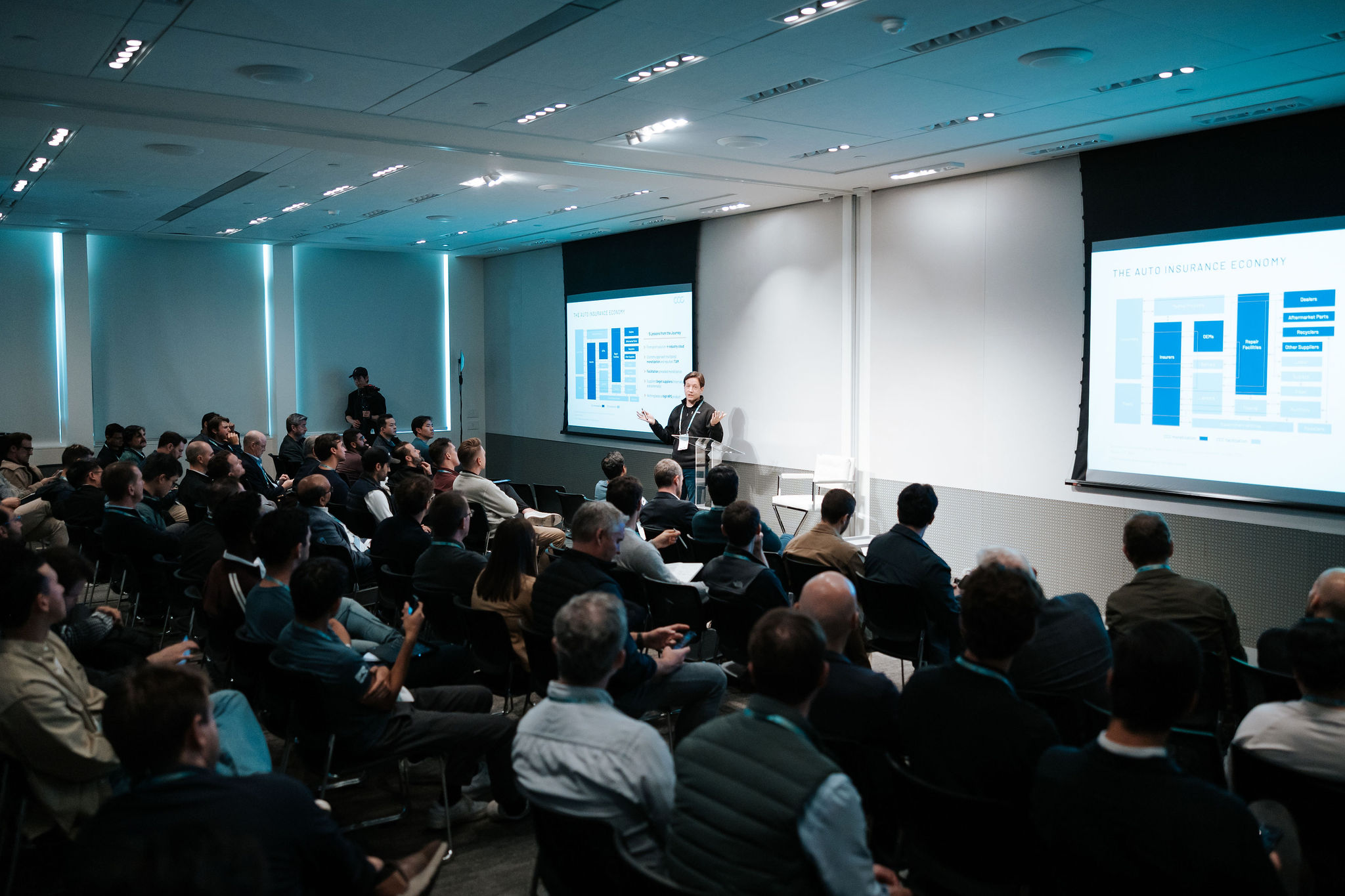
Marc Fredman’s talk was a masterclass in how a seemingly unglamorous vertical can grow into a billion-dollar network. CCC didn’t start as an “industry platform.” In 1980, it was a tiny point solution — replacing the scissors-and-newspaper method adjusters used to value totaled cars with a digital database of dealer prices. That narrow wedge became the seed for what is now the operating layer of the auto-insurance economy, largely because CCC kept widening its field of view as the industry revealed where the real interactions lived.
Fredman’s big reframing was the unit of analysis. A claim isn’t a transaction; it’s the first domino in a chain of hundreds. One claim triggers work across insurers, collision centers, parts suppliers, OEMs, diagnostics providers, lenders, and medical billers. His “auto insurance economy” map makes that concrete: dark-blue boxes for paying customers, light-blue for ecosystem participants. For 40 years, CCC has followed the same logic — digitize one box, connect it to the next, and turn that connectivity into value.
The arc looks like this:
Point solution < > insurer platform.
CCC began with total-loss valuation, then expanded into estimating and DRP connectivity between carriers and collision shops.
Insurer platform < > shop system of record.
Once CCC powered estimates and referrals, it built full shop management — intake, estimating, repair workflows, CRM/texting, and back-office tools. Today roughly 30,000 of the 40,000 U.S. body shops run on CCC.
Shop OS < > supplier networks.
With shops standardized, CCC onboarded their suppliers. Parts vendors started by sending prices and availability (light blue), and later moved into real-time ordering and invoice reconciliation (dark blue). For thousands of small shops, this erased the most hated daily chore: matching stacks of parts invoices to the right jobs.
Suppliers < > suppliers’ suppliers.
As vehicles added ADAS systems and sensor-heavy bumpers, diagnostics work exploded — up more than 1,900% since 2017. Shops were juggling OEM laptops and photographing scan results for insurers. CCC extended its network again, plugging directly into diagnostics providers cloud-to-cloud and creating another paid supplier tier.
The result is a three-level supplier model most Vertical SaaS companies never achieve. Roughly half of CCC’s ARR now comes from suppliers and suppliers-to-suppliers. A single claim may touch CCC revenue seven or eight times as it moves through the ecosystem. The same network also underpins a $100 million+ ARR AI business built on $2 trillion of historical claims data — not generic wrappers, but predictive and decisioning products that sit directly in the workflows.
Fredman boiled the lessons down for founders:
Every platform starts small.
Users don’t buy platforms; they buy outcomes. Start narrow, and sketch the “economy map” early so you’re building with the bigger graph in mind.
Think in economies, not personas.
If your TAM looks small, you may be defining it as “software for X role” instead of “orchestration of the X economy.” CCC unlocked far more TAM once it monetized the same claim across insurers, shops, and suppliers.
Facilitate first; charge later.
Every supplier network began as free facilitation — parts data, OEM data, diagnostics output. Over time, most of those light-blue boxes turned dark.
Suppliers beget suppliers.
Winning shops made it easier to win parts vendors; winning both strengthened CCC’s value to insurers and OEMs; OEM programs reinforced the shop OS. PE roll-ups of multi-shop operators weren’t a threat — they standardized on CCC and increased ARPU even with discounts.
Product quality is the moat.
Incumbency helps distribution, but it doesn’t guarantee retention. When a walk-in customer gives a shop a choice of estimating tools, 96 percent choose CCC. An NPS above 80 is what keeps the network from leaking.
Fredman ended with the point many founders overlook: supplier extensions aren’t an add-on. They powered CCC’s growth from roughly $300 million to more than $1 billion in ARR, with 99 percent gross dollar retention. By evolving from “claims software” to orchestrator of the auto-insurance economy — and now into adjacent spaces like workers’ comp and disability — CCC proved that networks compound, but only if you build the graph patiently and deliberately.
For a deeper dive into CCC’s journey, head to our case study here.
A huge thank you to Marc Fredman for joining us!

Stay in the Loop
Enter your details and be notified when we publish new articles on The Highpoint.